Showing posts with label Testing Phases. Show all posts

Tuesday, January 8, 2013

Testing Stages or Phases (Unit Testing)


2) Unit Testing: 
  • When the Design Documents are base-lined, corresponding Programmers can start Coding by writing Programs.
  • The same programmers can test these Programs to validate completeness and correctness.This process is called Unit Testing.
unit testing


  • This Unit Testing is also called as program testing / code testing / white box testing / glass box testing / open box testing / clear box testing.
In Unit Testing, Programmers  can follow white Box testing techniques they are  as follows:


a) Basic Paths coverage:

Programmers can use this technique to confirm that the Program is Running without any syntax and run time errors.
While applying this technique, programmers can follow below process:
  •  Write the Program
  •  Draw a flow Graph for that program and then 
  •  Find the Number of Paths in that Graph
  •  Run the Program that many times to cover Entirely.

Here in this 'Basic Paths coverage' technique, programmers goal is to cover all the regions.

Note: The number of paths in a program is called as "Cyclomatic complexity"(CC).

Example:

flow graph


       b)Control Stucture Coverage: 


Programmers use this Technique to validate that the  Program correctness in terms of Inputs and Outputs. This technique is called also called as 'Debugging'


Debugging : Checking a program line by line for correction of inputs and outputs.


    c) Program Technique coverage:

Programmers use this Technique to calculate the execution speed of a program. If program speed is not reasonable then programmer acn modify the proper structure without disturbing the functionality.

Example: Swapping of two numbers

A=10

B=10

C=A               (This logic will take less time and more memory)

A=B

B=C

 if we follow the above logic then we will get a=20 and b=10. in the same way let us apply the second logic which is as follows:
A=10
B=20

A=A+B           (This logic will Take less memory and more time)
B=A+B
A=A-B

if we follow the above logic then we will get a=20 and b=10 same as above.

As we know for any company time is most precious one, so programmers will apply the 1st logic.

    d) Mutation coverage:


Mutation means a change in program. Programmers use this technique to confirm that the program is tested completely or not.
In this Technique, Programmers perform a Change in Tested Program and Repeat Testing.

While conducting the re-testing, programmers can try to find the changes in that program. If the changes are not identified then that program testing is incomplete.
This mutation coverage technique is also called as 'Bebugging'. 


Testing Stages or Phases (Documents Testing)

From Fish, V and Agile Models of development process testing will get multiple stages.
1) Document Testing:

  1. It is the first stage in Software Development Process, Requirements Gathering will be done by Business Analyst ( BA ).
  2. Here, BA prepares a Document based on Customer Requirements called BRS / CRS / URS.
                BRS : Business Requirement Specifications.
                CRS : Customer Requirement Specifications.
                URS : User Requirement specifications.
      3.This BRS will be reviewed by the same BA for Completeness & Correctness.

Once BRS is base-lined, system analyst ( SA ) prepares SRS ( Software Requirement Specification ) depends on that  BRS.

example of srs brs


Here we can observe that SRS is divided in to FRS & NFRS.
FRS consists of Customer Requirements to be Developed and NFRS consists of Customer Expectations to be Achieved.
After completion of SRS preparation, Corresponding System Analyst reviews that SRS for its Completeness & Correctness.
Once SRS is base-lined, Corresponding Designers / Technical Architects concentrate on Software Design in High Level & in Low Level.
High Level Design(HLD - Project Level )
High Level Design shows the complete architecture of Software.

Example:
example of hld


Low Level Design's ( LLD's - Module Level )
Low Level Design provides the Internal Architecture or Logic for a Specific Module. so, thats why, One software or Project has One HLD and Multiple LLD's.
After completion of HLD & LLD's, Corresponding Technical Architrect(TA) can review those Designs for Completeness & Correctness.

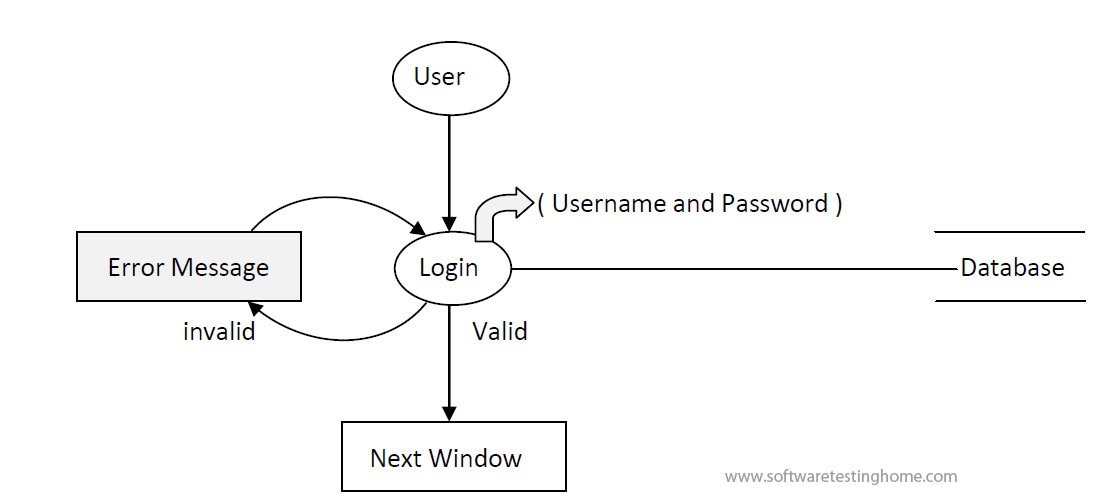
Example:
example of lld


Note: During above document testing, people can review documents by following 3 techniques such as walkthrough,inspection,and peer review


a) walk-through:
Walk-Through means a Document being studied from First to Last.
b) Inspection:
Inspection means searching a Factor in Document.
c) Peer review:
Peer Review means Comparing 2 Similar Documents.

Note:
Above 3 Techniques are also called as Documents Testing Techniques or Verification Techniques or Review Techniques or Static Testing Techniques.


Recommend on Google


Followers

Popular Posts